By ROFFS® | James L. W. King
Please click here to download the FULL 2025 Southern FL to Cape Hatteras Spring Season Preview
ROFFS® continues its spring preview series by providing an overall update of the oceanographic conditions during early April for the east coast of the United States from the Florida Keys north to Cape Hatteras, NC including the entire offshore Gulf Stream region. As always, we have used a combination of many different data sets, but mainly sea surface temperature (SST) and ocean color/chlorophyll images. We will discuss these overall ocean conditions for the present spring season and how these conditions may translate to the near future fishing season.
For forecasting short-term oceanographic conditions related to finding fish, ROFFS® uses real-time direct observations rather than unproven ocean models and longer-term composites. We have learned that evaluating the pre-season conditions, along with regional climate models, provides insight into future seasonal trends for fishing. Experience and understanding of the ocean – atmospheric dynamics is our guide as we have had moderate success in forecasting seasonal trends of fishing productivity based on the stepwise progression in the location of the fishes’ preferred habitat, based on temperature and water color. Please reference our 2026 Bahamas forecast for more in-depth discussion on the environmental and climate indicators that goes into our detailed evaluation of the southeastern United States fishing forecasting analysis (Click Here).
Background and Some Observations for 2026
It is important to look at the year-to-year trends including the anomalies to gain insight into the location and condition of the fishes’ preferred habitat compared with previous years. Examining the distribution of sea surface temperature (SST) throughout the southeast region reveals the oceanographic conditions for 2026 are approximately 2°F cooler than 2025 (2025: 75.5°F vs 2026: 73.8°F) on average during late March and early April. Comparing similar locations and features to last year during the same early April time period we found that the SST of the core of the Gulf Stream offshore of the Florida Keys to Miami, FL for 2026 was approximately 1.0°F-1.5°F cooler (at 79.1°F) compared to 2025 (80.6°F). This cooler trend continues northward as the core of the Gulf Stream from Cape Canaveral to Jacksonville, FL is approximately 1.0°F-1.5°F cooler (79.1°F) compared to 2025 (80.6°F) and further north to Cape Fear (2025: 80.1°F vs 2026: 78.4°F) and off Cape Hatteras (2025: 79.6°F vs 2026: 78.1°F).
While we continue to observe the formation of relatively large Gulf Stream eddy formations offshore of Charleston as the Gulf Stream interacts with the Charleston Ridge in a similar fashion to the 2025 season, these eddy formations have been slightly smaller and moved out of the area more rapidly in 2026. This has resulted in a prolonged series of these larger Gulf Stream eddy formations moving northeast off of Cape Fear to Cape Hatteras since February, 2026. That being said, we had also observed a brief pause in the Gulf Stream as a larger than normal eddy within the Florida Straits, also known as the Tortugas Gyre, slowed eastward movement of the warmer Loop Current water into the Florida Straits to become the Gulf Stream in early February. This spawned a long train of eddy formations along the western side of the Gulf Stream in February before stabilizing somewhat in March. Additionally, along the eastern side of the Gulf Stream, cooler, bluer water was able to push west/northwest from the Bahamas earlier, allowing for favorable conditions along the eastern side of the Gulf Stream as well. While still unstable, the proximity of cooler, Bahamas blue water appears to have improved conditions along the eastern side of the Gulf Stream for early tuna and blue marlin fishing.
Nowcast Analysis
The Gulf Stream Current, including its related eddies and filaments along the current’s eastern and western side are the preferred habitat of the highly migratory species for this time of year and are the most important conditions that we are studying. It is the day-to-day and hour-to-hour movements of these Gulf Stream related features that are important to monitor when deciding where to fish on a daily basis. Although we are only showing a two-to-three-day snap shot of the conditions in this report from early April (Figure 1a/b and 2a/b), we can discuss briefly the trends we see based on these early spring oceanographic conditions and related fishing reports that may provide insight into the near-future fishing season.
Figures 1a/b were derived from a variety of U.S. and European satellites during the early April period (April 04-06, 2026 and April 05-06, 2025) and Figures 2a/b were derived from NASA and NOAA’s VIIRS, Aqua MODIS, PACE ocean color/chlorophyll, and European Space Agency’s Sentinel 3 chlorophyll imagery during this same period (April 05-06, 2026 and April 05-06, 2025). As the exact values of the original data from different satellite sensors (VIIRS, PACE, Sentinel and MODIS) are not the same, we cross-calibrated the data to derive images that have realistic and consistent temperature and water color. This is one of the many techniques that we derived during the valuable NASA Earth Science Program projects that ROFFS® has been involved with. We cannot over-stress the importance of NASA’s Earth Science Program for helping to understand the ocean’s dynamic ecosystem and how it impacts food security, homeland security and land-ocean interactions.
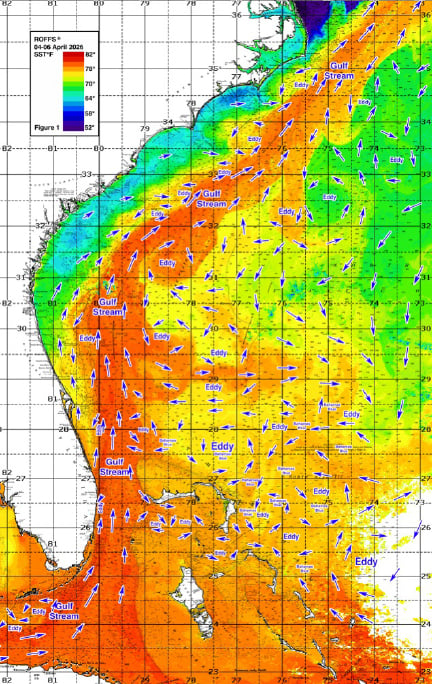
Figure 1a: This year’s Florida Keys to Cape Hatteras, NC conditions were derived from a variety of infrared sensors to get SST from NASA, NOAA, JPSS and ESA satellites during April 04-06, 2026. Main features and surface currents are labeled.
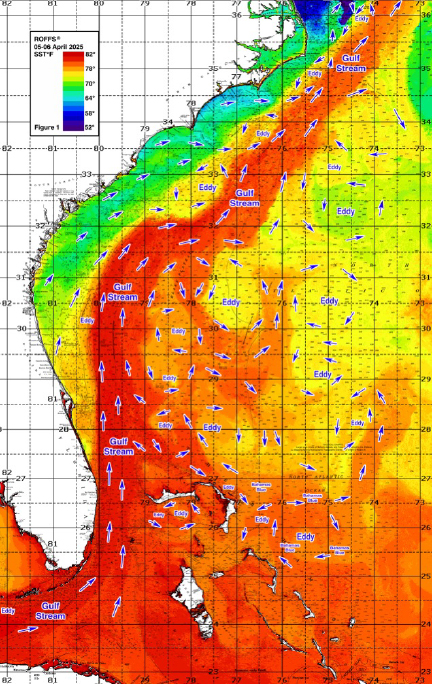
Figure 1b: Last year’s Florida Keys to Cape Hatteras, NC conditions were derived from a variety of infrared sensors to get SST from NASA, NOAA, JPSS and ESA satellites during April 05-06, 2025. Main features and surface currents are labeled.
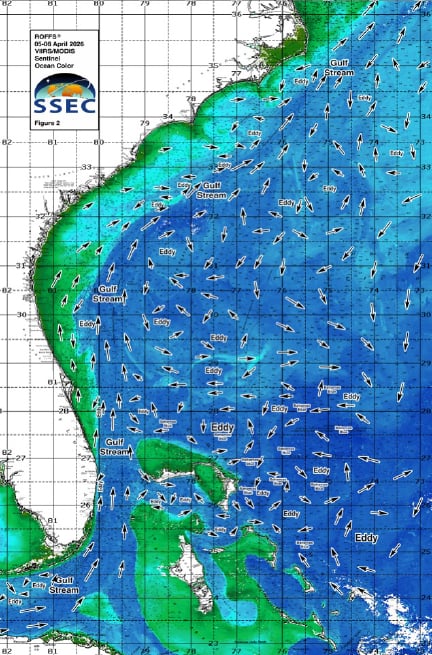
Figure 2a: This year’s Florida Keys to Cape Hatteras, NC conditions derived from the ocean color/chlorophyll imagery during April 05-06, 2026 from the VIIRS sensors on SNPP and NOAA 20/21 satellites and the Aqua and PACE sensor on the NASA satellites provided by University of Wisconsin-Madison in combination with the ESA’s Sentinel 3 satellites. We consider this an image pair with the above SST Figure 1a image. Same main features and surface currents labeled.
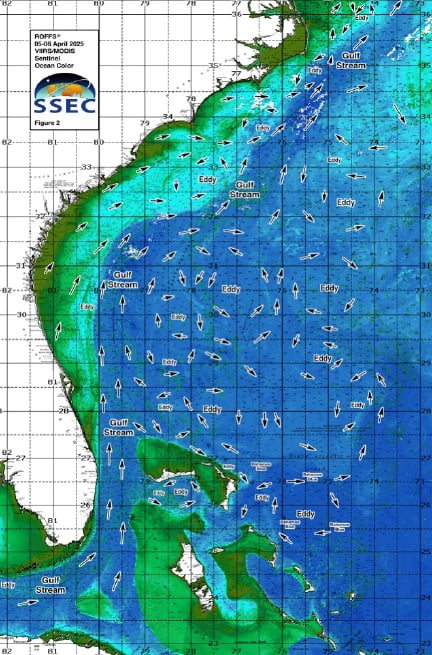
Figure 2b: Last year’s Florida Keys to Cape Hatteras, NC conditions derived from the ocean color/chlorophyll imagery during April 05-06, 2025 from the VIIRS sensors on SNPP and NOAA 20/21 satellites in combination with the Aqua and PACE sensors on the NASA satellites provided by University of Wisconsin-Madison in combination with the ESA’s Sentinel 3 satellites. We consider this an image pair with the above SST Figure 1b image. Same main features and surface currents labeled.
We were able to use imagery from April 4th-6th for this year’s analysis. The directional flow of the water was derived from our ROFFS® sequential image analysis, following the water from image to image based on the water masses distinct, i.e. signature value. An example of this year’s SST satellite infrared imagery in greytone can be found on the ROFFS® YouTube® site (Click Here). Viewing the movie will allow one to follow the flow of the water and numerous eddies within the Gulf Stream region from offshore of eastern and southern Florida to North Carolina during the last month, where the darker greytoned water represents the warmer water and white indicates clouds.
Conclusion
Based on what we have been observing over the last several weeks, the present overall early April ocean conditions (SST) for the Gulf Stream region between the Florida Keys to Cape Hatteras, NC appears cooler than what we had observed in the prior year. This could be due to the cooler than normal winter we experienced this year. This decrease in sst° could indicate an on time or slightly later start for the main southeast U.S. fishing season. However, the earlier presence of “Bahamas blue marlin water” moving northwest from Abaco may indicate a more normal to early start to the season compared to last year as this water begins interacting with the eastern side of the Gulf Stream and moving northwards into the Georgia to North Carolina coastline. Fortunately, we have begun receiving reports of decent tuna and blue marlin action north of the Bahamas and into the eastern side of the Gulf Stream north of the Corner/Matanilla Shoal. Additionally, south Florida mahi and sailfish action has been strong, but not quite as consistent as last year during this time. However, early April reports of sailfish are heating up in South Florida. Reports of average to below average wahoo from north Florida to Georgia suggests that the fish are in the area when conditions are right. As a result, now is a good time to be either fishing already or your boat should be in the water waiting for that weather window. We want you to take advantage of the good ocean conditions and the early fishing season. Once the water begins to warm after what appears to have been one of the last of the seasonal cool fronts pass through, the offshore fishing season will be well underway within most of the areas from Cape Canaveral to Cape Hatteras. It will likely not be long until the main migration of marlin, yellowfin tuna, and mahi will be available off of North and South Carolina. We have not had many reports of bluefin tuna off of Florida, but it was a strong bluefin tuna winter to early spring season off of Virginia and North Carolina suggesting they will be migrating through in larger numbers right now or soon.
It is important to note that good fishing action on a daily basis is strongly linked to local, short-term (daily) current conditions that concentrate the fish once the preferred habitats of the fish are in a particular region. When the water mass boundaries associated with these currents are geographically stable and favorable, i.e., persistently pushing over “good” bottom topography and/or in a favorable inshore direction, then they concentrate the baitfish and larger fish can be found foraging. Relatively short-term (hourly/daily) and relatively small-scale (1-5 mile) movements of the currents and their associated water mass boundaries are often in control of the level of fishing productivity on any given day. Our experience indicates that to reliably forecast specific concentrations of fish on a daily basis one must evaluate the ocean conditions on these scales. Relatively small subtle changes in the currents and their associated water mass boundary zones often have dramatic effects on the distribution and concentration of fish.
The Gulf Stream conditions change rapidly so it becomes even more important to contact ROFFS® (321.723.5759 / [email protected] / www.roffs.com) for daily up-to-date detailed fishing forecasting analyses and get the inside track to where the better conditions will be tomorrow. We continue to monitor the coastal southeastern U.S. Ocean conditions and its related eddy features and how it relates to the local fishing environment as the larger recreational and tournament fishing season approaches. Get out and fish now and maximize your fishing experience by using ROFFS® to locate the good spring conditions near you. Lastly, check out our new product FishCast® powered by ROFFS® an automatic modeled forecast of the better fishing conditions overlaid directly on your Simrad® chart plotter with no additional hardware or on a desktop viewer. This is a great supplement to our regular analyses to improve your experience out on the water. Check out this website for more information. https://www.simrad-yachting.com/fishcast/ and thank you for your continued support.
Safe and Successful Fishing
Team ROFFS®