Please click here to view full 2026 ROFFS® GOM Season Fishing Forecast as a PDF.
By Gregory J. Gawlikowski
Introduction
Continuing our series of “Early Season Previews”, ROFFS® is providing a spring analysis of the oceanographic conditions for the Gulf of America region derived using a combination of high-resolution satellite data including infrared sea surface temperature (SST) and ocean color/chlorophyll images from late April-early May 2026. In this preview, we will discuss the overall ocean conditions for the current spring fishing season and how they may transition into the summer conditions compared to the similar time period last year.
ROFFS® (www.roffs.com) has a 39-year history of monitoring the ocean conditions throughout the Gulf of America for research and fishing applications. Infrared (IR) satellite data is used to observe the SST and ocean color data is used to derive indices of phytoplankton (chlorophyll), water clarity, water color and colorized dissolved organic material (CDOM). Combined with other oceanographic data and using sequential image analysis, these data allow one to visualize the dynamic ocean currents. The satellite data are derived from a variety of sources including NASA, NOAA, University of Wisconsin and the European Space Agency (ESA). ROFFS® also incorporates a variety of different data derived from NOAA buoys, drifting buoys and satellite altimeters into its comprehensive fishing forecasting analyses. The altimeter data provides a relatively coarse spatial (~10 mile) and temporal resolution (5-7 days) that limits the data’s usage to studying large-scale circulation. It is generally not useful for evaluating smaller scale, near shore and short-term (daily and sub-daily) changes in the ocean currents or their water mass boundaries that often control the location of forage (bait) fish and the larger, more valuable predator/pelagic fish.
Background and Some Observations for 2026
It is important to look at the year-to-year trends and anomalies, along with fishing reports, to get a better understanding of how the ocean conditions (SST and Ocean Color/Chlorophyll) compare and location of the fishes preferred habitat and the likelihood of a productive fishing year. Comparing the similar locations and features to last year, the SST of the core of the Loop Current for late April/early May 2026 (Figure 1a) is approximately (81.5°F-82.5°F) which is about the same over the same time period last year (Figure 1b) and also about the same as the past five years over this same time period. Please note that this year, while there are some intrusions of relatively warmer (77°F-79°F) water with direct Loop Current origins moving over the Lloyd Ridge, this water cools as it is pulled inshore towards the Double Nipple and De Soto Canyon areas which is likely why this year there seem to be more catches of larger bluefin tuna in the northeastern Gulf/De Soto Canyon FAD areas and not so many reports of yellowfin tuna and blue marlin as of yet. This is mainly due to the influence of several smaller eddy features along the northern boundary of the Loop Current towards the De Soto Canyon.
Inshore towards the Spur and Nipple areas the water is significantly cooler inshore of 50-70 fathoms, this year being 74°F-76°F, while last year (2025) these inshore waters had already warmed to 78°F-80°F. This is likely due to the passage of several late-season cold fronts through the area over the past 2-3 weeks and once the air temperatures warm over the next week to ten days as forecasted, the inshore temperatures are likely to rise and bring in larger populations of target species. The main body of the Loop Current does seem to occur at a similar latitude compared with the past two years with the northern edge of the main body of Loop Current water occurring southward towards 26°30’N along 87°00’W. Again, this year, we observed a clockwise rotating Loop Current eddy feature break off from the main Loop Current circulation; however, this year this feature is somewhat smaller continuing to progress very slowly southwestward between the Mississippi Canyon and the Green Canyon area currently centered in the area near 27°30’N & 90°15’W. While this feature appears to be pulling dirty green water from the Mississippi River Delta region and over the Mississippi Canyon and around the perimeter of the eddy resulting in slow fishing action, at the same time, this Loop Current eddy feature appears to be pulling an abundance of cleaner blue water from offshore directly over the Green Canyon area resulting in very good recent yellowfin tuna and blue marlin catches in this area.
The SST in the northwestern Gulf of America is currently approximately 76.0°F-78.0°F inshore, which is approximately the same SST as we observed in this area last year. A large counter-clockwise rotating eddy (centered near 27°15’N & 94°30’N) in the area of the Dump Site appears to be keeping the SST cooler to the north over the Flower Gardens area and inshore towards the area offshore of Aransas Pass. Southward, a large clockwise rotating eddy (centered near 24°45’N & 94°30’W) appears to be pulling relatively warmer water (78°F-80°F) blue water originating from Mexico over the 100-500-1000 fathom depths offshore of the Colt 45 and Texas Canyon areas before turning more offshore eastward between the circulation of the two previously discussed eddy feature. This is very different from what we observed in these areas last year (Figure 1b) with the larger clockwise rotating eddy occurring much further south this year along with the presence of the large counter-clockwise rotating eddy this year, although the general SST in the western Gulf of America appear to similar to what we observed during this same time period last year.
The warm SST again this year are likely to lead to some normal arrivals of pelagic species this year in the western Gulf of America (early to mid-May). The SST in the offshore southwestern Gulf of America area was observed to be within the 81.0°F-82.7°F range this year which is slightly warmer than last year (80.0°F-82.0°F) and slightly warmer than the 79.0°F-81.0°F range we observed in 2023/2024. Overall, the overall SST in the southwestern Gulf of America remains much warmer than the 76.0°F-77.0°F that was observed back in 2018/2019.
Note that the coastal SSTs along the west coast of Florida (76.0°F-77.7°F) are showing temperatures similar to last year, but 1.5°F-2.0°F warmer when compared to 2024 (74.0°F-76.0°F) with the warmer waters reaching as far inshore as the 10-20 fathom depths offshore of Tampa this year. Normally, a strong contributor to the warmer SSTs is the presence of an El Niño period. We are currently in an ENSO neutral phase which suggests more average overall SST and is expected to persist at least through June (80% chance) with a 60% change of an El Niño phase emerging sometime during May-July and persisting at least through the end of 2026
Currently there is a small to medium size, detached Loop Current eddy feature present in the central Gulf of America centered between the Mississippi Canyon and Green Canyon areas. During April 2026 we were able to observe several eddy features, both clockwise and counter-clockwise rotating, located southeast of the Mississippi River Delta region and north/northwest of the main Loop Current circulation that continue to pull clean blue water with direct Loop Current origins northward between the Lloyd Ridge and the Atwater Valley and northeastward towards the Steps region and the area of the De Soto Canyon area with some of this water being circulated towards the Spur and the area south of the Nipple by an additional counter-clockwise rotating eddy feature that has persisted in the De Soto Canyon over the past month or so. This circulation continues to pull some of the cleaner blended blue to blue water inshore towards the Squiggles and Wings regions and westward north of the Spur over the Unexploded Ordnance towards the Nipple/Elbow regions. This circulation, along with relatively warm SST’s in the northeastern Gulf of America, support normal arrival time (early-to-mid May) of the pelagic species that you usually target offshore (e.g. yellowfin tuna, wahoo, dolphin, kingfish, sailfish, marlin, swordfish, cobia, etc.) as indicated in the fishing reports below.
Recent reports indicate that kingfish action again this year has been decent in March and April offshore of western Florida with sailfish, dolphin (mahi-mahi) and blackfin/yellowfin tuna being caught offshore of southwest FL particularly along the east northeastern edges of the warmer bluer water pushed inshore over the 20-50 fathom ledges inshore of the main Loop Current circulation. There have also been reports of excellent blue marlin action, along with several yellowfin tuna southwest of LA and Mississippi Canyon in the Green Canyon area and near the offshore rigs. This is not surprising due to the presence of the clockwise rotating Loop Current eddy centered between the Mississippi Canyon and the Green Canyon and also based on the circulation and SST’s we have been observing in the area of the Green Canyon towards the area west/southwest of the Mississippi Canyon, south/southeast of the Mississippi River Delta and eastward towards the Steps, Nipple, Elbow, Spur and southward into the De Soto Canyon.
Nowcast Analysis
For forecasting short-term oceanographic conditions related to finding fish, ROFFS® first uses real-time direct observations based on high-resolution satellite data rather than unproven and unreliable ocean models or longer-term composites. We have learned that evaluating the preseason conditions along with regional climate models provides insight into future seasonal trends for fishing. Experience and understanding the ocean – atmospheric dynamics is our guide as we have had moderate success in forecasting seasonal trends of fishing productivity based on the stepwise progression in the location of the fishes’ preferred habitat based on movement of water masses, stability, temperature (SST) and water color.
The circulation of the Gulf of America is controlled by the location and flow of the Loop Current, large mesoscale eddies, local and regional winds, and the dynamic thermohaline forces of the fresh water runoff mixing with the ocean water. The Loop Current is a warmer ocean current that flows northward between Cuba and the Yucatan Peninsula into the Gulf of America. It makes a “loop” east/northeastward within the eastern Gulf then southward before exiting through the Straits of Florida and re-joining the Gulf Stream. It is the dominant circulation feature in the eastern Gulf of Mexico and its location varies on a weekly, monthly and annual time scale. The Loop Current and related eddies can be a highway and spawning grounds for pelagic fish moving into the Gulf of Mexico from the Caribbean Sea. The eddies that the Loop Current sheds can be an important fish habitat for longer periods of time as they progress from the eastern Gulf of America to the northeastern, central and western Gulf of America over a time period of several months.
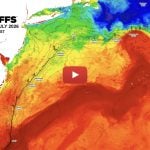
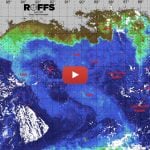
Figure 1a was derived from a variety of satellite data (from NASA, NOAA, and ESA) showing SST during the late April to early May (April 29-May 1, 2026) period and Figure 2a was derived from the SNPP and JPSS VIIRS, Sentinel 3A and 3B, Aqua MODIS, and PACE ocean color/chlorophyll sensors during this same period (April 29-May 1, 2026). As the exact values of the original data from different satellite sensors are not the same, we cross-calibrated the data to derive images that had realistic and consistent watercolor. This is one of the many techniques that we derived during the valuable NASA Earth Science Program projects that ROFFS® has been involved with over the years.
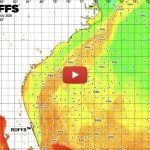
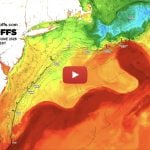
Figure 1b was derived from a variety of satellite data (from NASA, NOAA, and ESA) showing SST during the late April to early May (April 29-May 1, 2025) period and Figure 2b was derived from the SNPP and JPSS VIIRS, Sentinel 3A and 3B, Aqua MODIS, and PACE ocean color/chlorophyll sensors during this same period (April 29-May 1, 2025).
We could not use single and same day imagery for the SST and ocean color data due to cloud cover interference, so we used a combination of imagery and the time-tested ROFFS® cloud reduction techniques to produce these relatively cloud-free images. However, for comparison purposes we consider these images as an equal image pair for the purposes of this discussion. The directional flow, not speed of the water was derived from our ROFFS® sequential image analysis, following the motion of the water from image to image based on the water masses distinct, i.e. signature value. An example of this year’s SST satellite infrared imagery in greytone can be found on the ROFFS® YouTube™ site (https://www.youtube.com/watch?v=Dsta-ovjZ70). Viewing the movie will allow one to observe the flow of the water within the Gulf of America region during the last two months (March 1-May 1, 2026), where the darker greytoned water represents the warmer water and white indicates clouds.
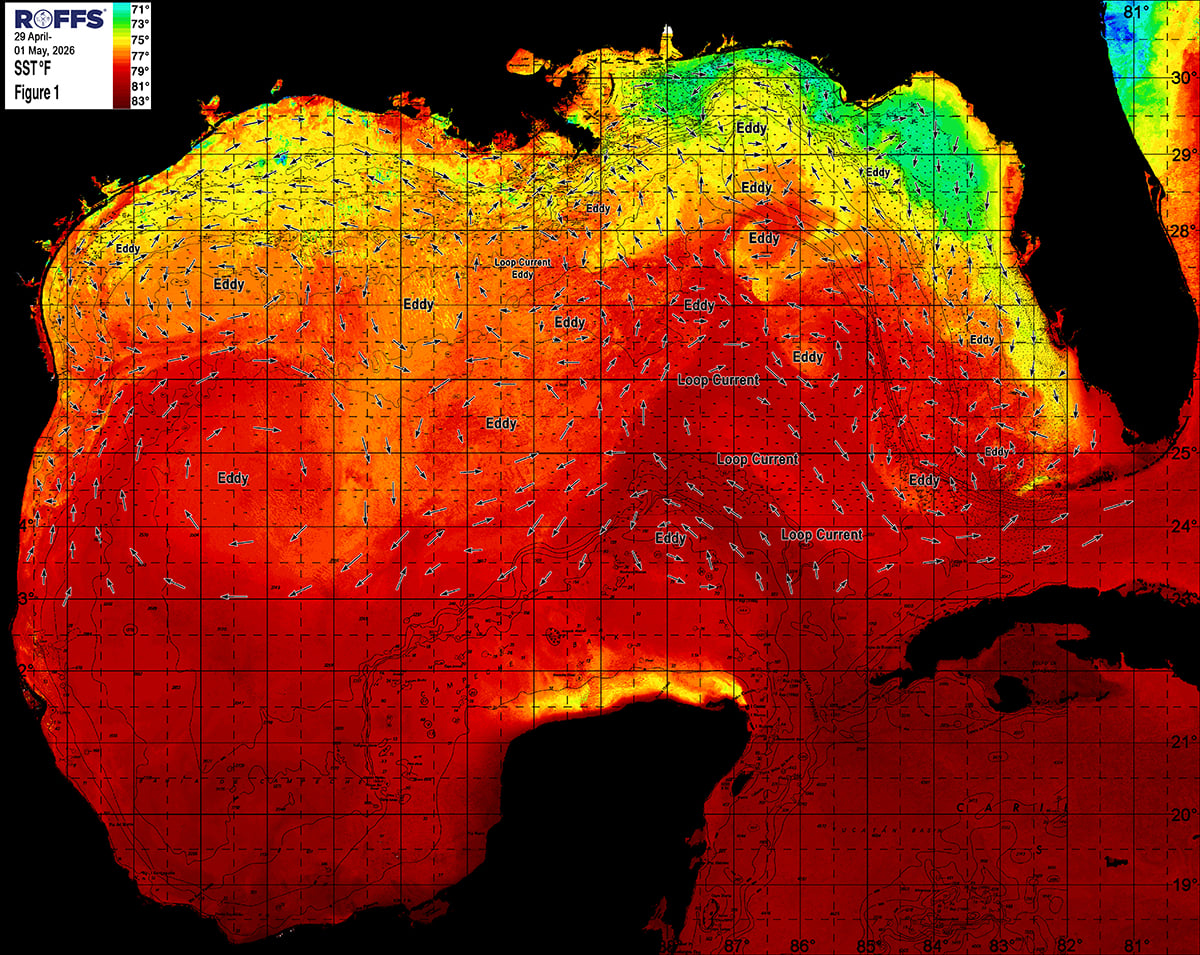
Figure 1a: This year’s Gulf of America conditions were derived from a variety of infrared sensors to get SST from NASA, NOAA, and ESA satellites during April 29-May 1, 2026. Main features and surface currents are labeled.
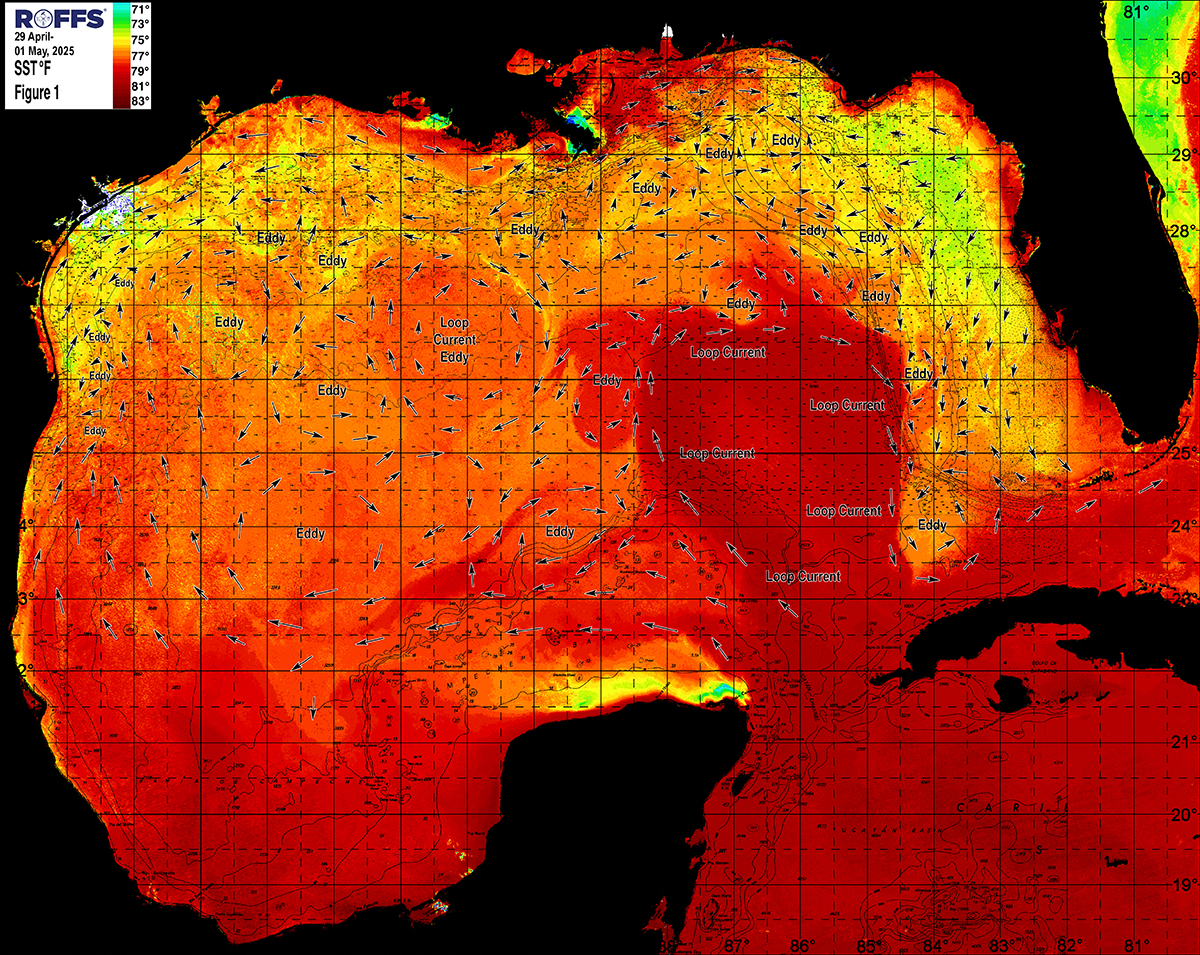
Figure 1b: Last year’s Gulf of America conditions were derived from a variety of infrared sensors to get SST from NASA, NOAA, and ESA satellites during April 29-May 1, 2025. Main features and surface currents are labeled.
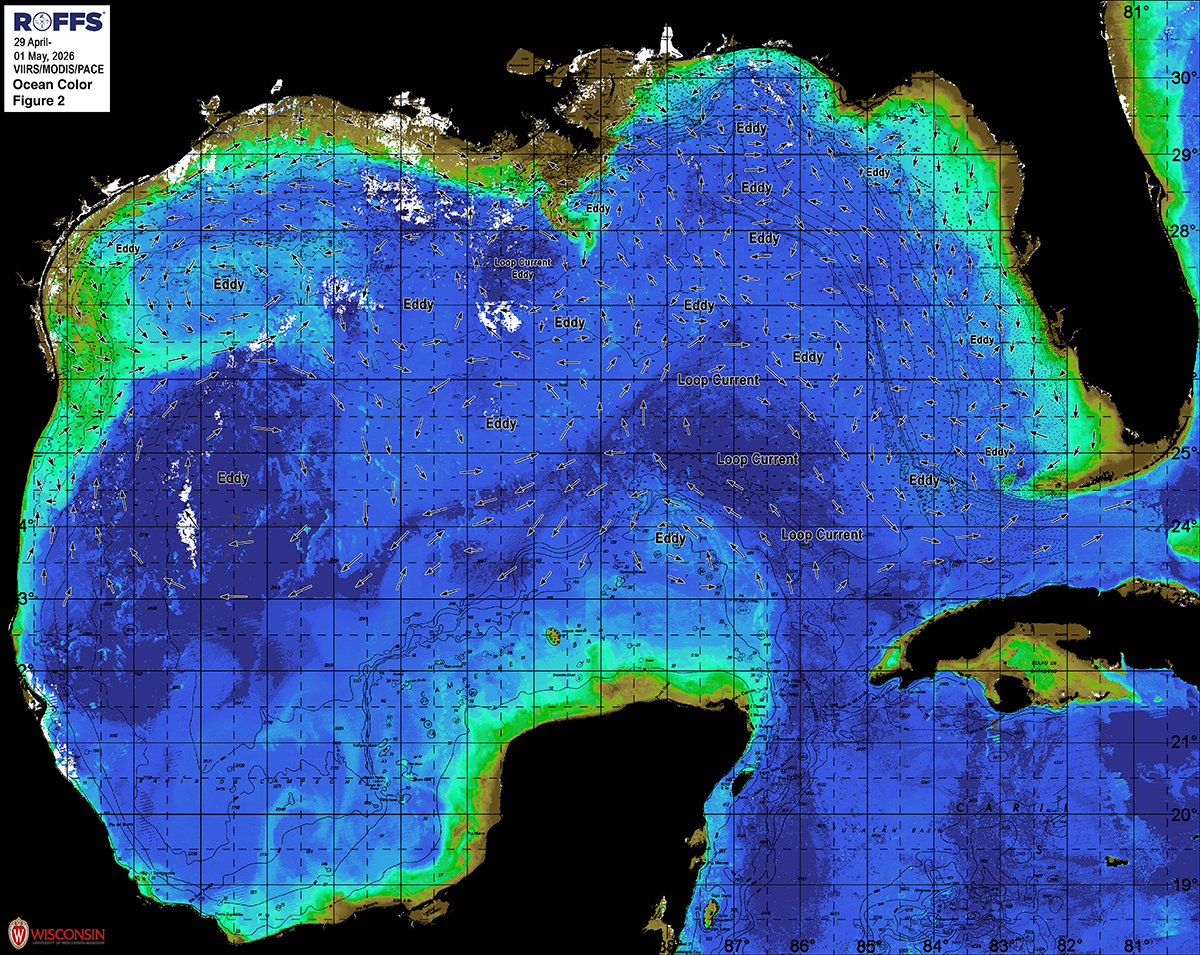
Figure 2a: This year’s Gulf of America conditions derived from the ocean color/chlorophyll imagery during April 29-May 1, 2026 from the VIIRS sensors on SNPP and JPSS satellites in combination with the Aqua sensors on the MODIS satellite provided by the University of Wisconsin SSEC and from ESA’s Sentinel 3A & 3B and PACE satellites. Same main features and surface currents labeled.
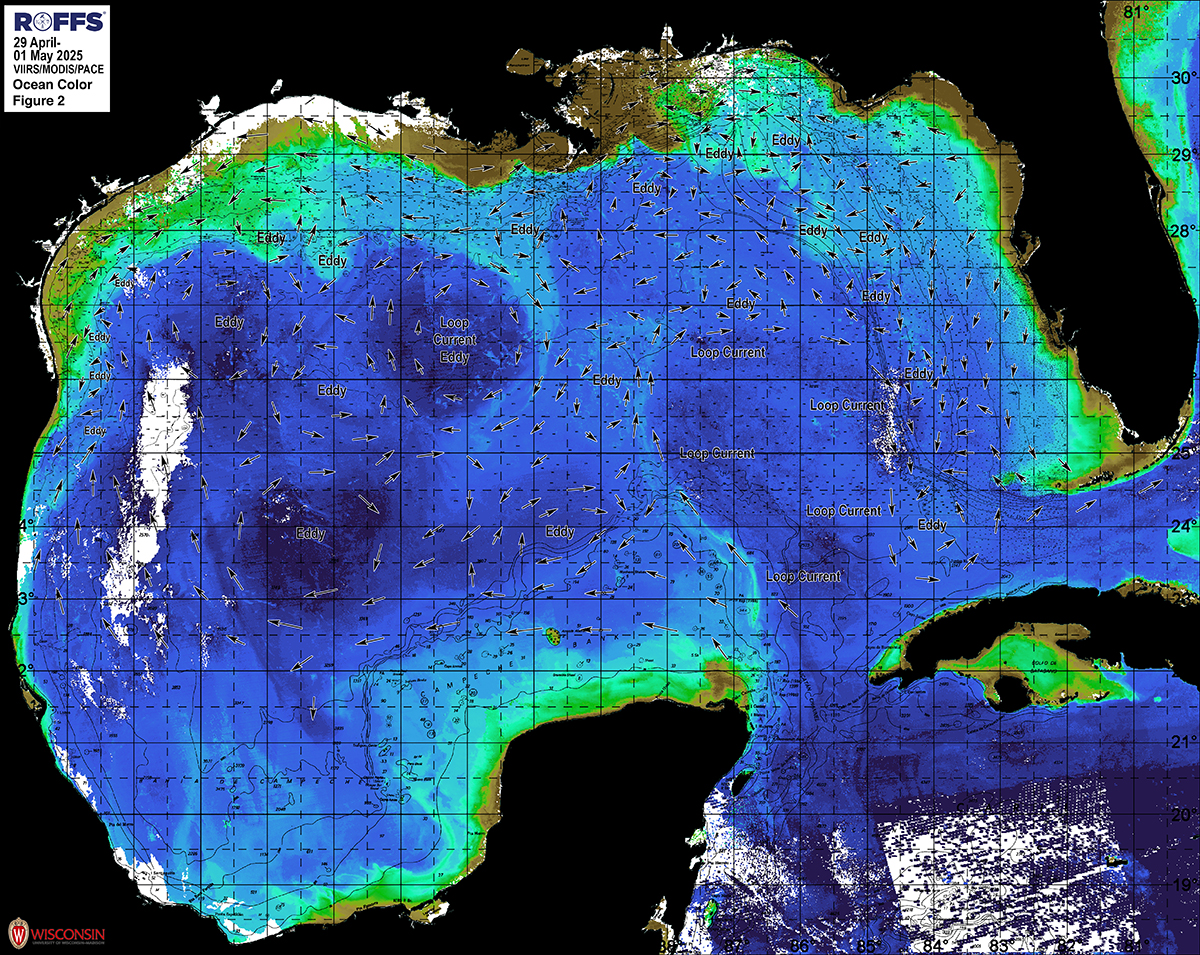
Figure 2b: Last year’s Gulf of America conditions derived from the ocean color/chlorophyll imagery during April 29-May 1, 2025 from the VIIRS sensors on SNPP and JPSS satellites in combination with the Aqua sensors on the MODIS satellite provided by the University of Wisconsin SSEC and from ESA’s Sentinel 3A & 3B and PACE satellites. Same main features and surface currents labeled.
When evaluating this year’s late April to early May oceanographic conditions, we continue to observe the northern location of the main body of the Loop Current located in a more typical position again this year. Also, this year we did again observe one clockwise rotating Loop Current eddy (although not as large as last year) along with several smaller clockwise and counter-clockwise rotating eddy features north/northwest of the main Loop Current circulation which have pulled up the cleaner blue water with direct Loop Current origins further north/northwestward over the De Soto Canyon with additional eddy features pulling the cleaner blended blue to bluer water further inshore towards the Unexploded Ordnance, the Spur, the Steps and southwestward towards the areas south/southeast of the Mississippi River Delta region. These conditions likely account for the recent early season catches of bluefin tuna, yellowfin tuna, dolphin, wahoo, swordfish and early season blue marlin (particularly further offshore) in the northeastern Gulf of America. As the surface SST warm over the next 1-2 weeks these catches are likely to begin to increase.
Furthermore, although the main eastern edge of the Loop Current is 100+ miles west/southwest of Tampa, FL again this year, there is an abundance of cleaner blended blue to bluer water over the areas inshore of the northeastern Loop Current edge and within 20-30 miles of the western FL coastline again this year for good chances at fishing action particularly where these conditions persist for multiple consecutive days. In the eastern Gulf of Mexico, it is important to keep an eye on the Loop Current and the detached Loop Current eddy and how they move and change in the next month. Some things worth watching are if the main Loop Current eddy keeps sliding southwestward and if the northern edge of the main Loop Current circulation keeps circulating Loop Current water further northward into the De Soto Canyon and how it interacts with the clockwise and counter-clockwise rotating eddies located north/northwestward of the main Loop Current flow. These changes will determine where the better fishing locations offshore of Florida, Louisiana, Alabama and Mississippi over the late spring to early summer season will occur.
Offshore of Texas and in the western Gulf of America, two key clockwise rotating eddy features, one counter-clockwise rotating eddy (centered near 94°30’W & 27°15’N) and one clockwise rotating eddy (centered near 94°30’W & 24°45’N), continue to circulate warmer blue water over the offshore rigs and good bottom areas offshore of the TX coastline offshore of the 500+ fathom depths, south of the Dump Site and south of the East Breaks and Flower Gardens regions. Stay tuned and call ROFFS® to get updated conditions within this entire Gulf of America region to find the best locations to fish nearest to your inlet.
Conclusion
Based on what we are observing currently, and what we have been observing over the last several weeks during April and into May, the present ocean conditions for the Gulf of America region along with recent fishing reports (thank you!) continue to look encouraging again this year. The overall conditions and main features look very similar when compared to this same time period over the past two years and much of the SSTs are already within the preferred fishing habitats of tuna, wahoo, dolphin and billfish along with bluer water over most of the typical fishing zones within the Gulf of America early this spring season. The overall takeaway is that the majority of the Gulf of America SSTs are similar to what we have observed over the past three years and again in line with what we had observed during the favorable early fishing season that has occurred over recent years.
Also, there appears to be an abundance of bluer cleaner water closer to the coast in many regions similar to what we had observed over the past three years. Although, the relatively warmer water appears further offshore of Texas again this year early in the season due to the presence of the large counter-clockwise rotating eddy, we expect this feature to continue to circulate cleaner water inshore over the coming weeks and as the atmospheric temperatures warm, so will the SST, bringing in the bait (and the pelagic fish). The warmer SST observed again this year is very likely to mean a normal arrival of the larger numbers of target fish species closer to shore.
Furthermore, the large Loop Current eddy present this year in the central Gulf of America, along with the abundance of other favorable blue water features (smaller eddies) in the northeastern Gulf of America are likely to continue to keep the warmer water within these preferred fishing structure zones allowing the already favorable fishing conditions to continue through the spring and into the summer season. Of particular interest, although the northern edges of the main Loop Current circulation appear to be at a “normal” latitude, there are large amounts of bluer water with direct Loop Current origins water far northward west/southwest of the Mississippi Canyon and into the Green Canyon and northeastward towards the De Soto Canyon for good early season fishing conditions directly offshore of Alabama, Mississippi, and Northwest Florida right now and this should continue for the next few weeks and may even improve further IF the northern edge of the main Loop Current circulation pushes further northward and continues to inject warmer, dark blue water directly into the areas south/southeast of the Mississippi River Delta region.
Overall, we think that the Gulf of America conditions for spring to early summer are above average again this year and are shaping up very well for rest of the spring season into the summer fishing season. We believe now is time to start fishing and call ROFFS® for the latest and greatest updates to the changing ocean conditions. Please continue to get your fishing reports and photos in to us at [email protected] and be sure to follow us @roffsfishing on Instagram and Facebook. When you send in your photos please send us your Instagram info if we do not have it so we can request a collaboration and appropriately tag your account when posting.
It is important to note that good fishing action on a daily basis is strongly linked to local, short-term (days) current conditions that concentrate the fish once the preferred habitats of both the baitfish and larger predatory pelagic fish are in a particular region. When the water mass boundaries associated with these currents are geographically stable and favorable, i.e., persistently pushing over “good” bottom topography and/or in a favorable inshore direction, then they concentrate the baitfish and larger fish can be found foraging. This indicates that the fishing action on any given day is controlled by relatively short term (hourly to daily) and relatively small-scale (5-10 mile) movements of the currents and their associated water mass boundaries. Our experience indicates that to reliably forecast specific concentrations of fish on a daily basis one must evaluate the ocean conditions on these scales. Relatively small subtle changes in the currents and their associated water mass boundary zones often have dramatic effects on the distribution and concentration of fish, therefore it is extremely important to monitor these conditions and the changes in them on a daily basis.
Contact ROFFS® (321-723-5759 / [email protected] / www.roffs.com) for daily real-time detailed fishing forecasting analyses and get the inside track to where the better conditions will be tomorrow or while you are out fishing. We continue to monitor the Gulf of America conditions and how they change from day-to-day as the recreational fishing season has arrived and the bigger tournament fishing season is arriving soon. The bottom line is: CONDITIONS LOOK GOOD AGAIN THIS YEAR – GET OFFSHORE NOW and take advantage of the favorable weather windows, for the good to excellent spring season fishing conditions have already started and should continue to improve throughout May and into the early summer months. Lastly, check out our new product FishCast powered by ROFFS® an automatic modeled forecast of the better fishing conditions overlaid directly on your Simrad® chart plotter or on a desktop viewer with no additional hardware needed. This is a great supplement to our regular analyses to maximize your experience out on the water and save time and fuel. Check out this website for more information, https://www.simrad-yachting.com/fishcast/ then https://www.c-map.com/fishcast/getting-started/. Thank you for your continued support.
Safe and Successful Fishing!
ROFFS® Team